[I'm going to try to avoid the political debate and stay on the topic of tech adoption and innovation. There is incredible work being done in this space, regardless of the politics behind it.]
This past year we heard a lot of big headlines and saw sneak peeks of new technologies laying "just over" renewable energy horizon. Fuels from algae, fuels from trash, new thresholds of efficiency in solar cells being achieved almost daily, and some awesome home wind turbines. Problem is, most of these technologies are still either too expensive for widespread adoption or are still making their way from the lab bench.
So What's in Store for 2010?
Sadly, it'll probably be more of the same. We'll see fantastical headlines. Our blood pressures will rise, if only momentarily. Days and weeks will pass and the story will be forgotten. Then we'll see another jaw-dropping story and the cycle will repeat itself. We aren't seeing plug-in hybrids or hydrogen anything hit the market in 2010. We'll see industrial advances, but little in the consumer space worth getting excited about.
Labs and "Big Energy" Will Advance Quickly
Technologies will advance, there is no doubting that. We'll continue to get wowed by lab-scale achievements, and new breakthroughs 5 years to a decade from commercialization. We'll also continue to hear about rapid commercialization by large utilities and small entrepreneurial companies for industry-level innovations. We'll hear about wind farms, solar fields, the "clean coal" advancements, carbon sequestration, and even some really wild geoengineering proposals. Some will be hot air, sensationalist, and get a ton of press. Others will be quiet, but important, advances that will do more for this industry than we will probably ever know--or hear about.
What About Us?
But what we're all waiting for, and continue to wait for, is economies of scale. When will we see panels cheap enough to install on everyone's roofs? When, particularly for the windy state of Oklahoma where I reside, will tax credits (or better yet, just the retail price in the first place) be worth it to make the investment?
Moving Past Break Even
From my limited research it seems that we are getting nearer to that tipping point. Many home turbines, like the one linked to above, are right at that critical point where the investment, minus tax credits and energy savings throughout the life of the product, reach the break-even point. As such, the only people willing to spend the time and money to just break even are the ones on the fringe who are avid and extremely early renewable energy adopters with cash to spare. What we need is products that will save people considerable money over the long run. That is the only way we'll see rapid and widespread adoption. When it's cheap and easy to use renewables, they'll be adopted. This will be true in wind, solar, and geothermal. Unless we see an uptick in the size of tax credits available to us, or dramatic price reductions as these companies move more inventory, we won't start seeing widespread adoption until 2011-2015 (depending on the tech).
Efficiency, Efficiency, Efficiency
The space in which we'll see the most rapid change will be not on energy generation, but in energy savings in the efficiency of everyday products we already use. Companies like Serious Materials will continue to ship vast quantities of ultra-efficient sheetrock and windows for homes. LED and compact fluorescents will continue to gain market share, and costs will come down. Electronics are getting more and more efficient. And yet, the overall impact will be marginalized by the current economic wobbles. The folks with the cash to make dramatic improvements in their homes are keeping it in their pillowcases. We'll see improvements in 2010, but nothing too dramatic here.
What Can We Do?
Keep your eyes open. A few companies and renewable energy innovations for the home may start to peek through the clouds and sell for attractive prices or long-term energy savings offsets. Take a look at the federal tax credits available, and what your specific state's tax credits look like (states differ widely). There are some great opportunities there. Don't be afraid to call up some of these companies and talk to them about it. They basically have to have someone on staff managing the different tax credits and reimbursements--they wouldn't sell much without them, sadly.
My Energy Resolution for 2010, and a Challenge to You
Find a renewable energy technology you connect with. Find a product you think is cool, made by a company trying to change the world. Call them. Work with the company to find a way to get one in your home. Move beyond the break-even.
I've got my eye on a few vertical axis wind turbines (VAWTs). I'm hoping to bring one home this year. It's poised to be a windy 2010 in Oklahoma, as usual. And I'm going to make the most of it.
Wednesday, December 16, 2009
Tuesday, December 8, 2009
MicroFAIL: An Entrepreneur's Best Weapon
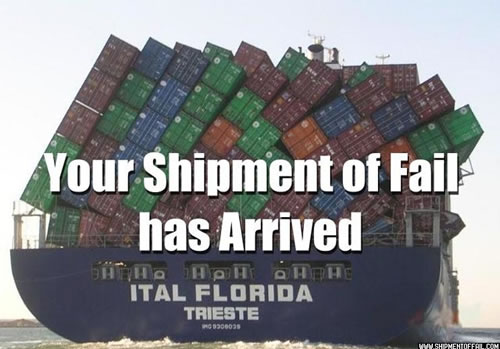
Isn't a MicroFAIL much more appealing than this?
Adjust, Tweak, Repeat.
The shorted distance between two points is a straight line. We learned that very early in school. So making a lots of quick, minor changes will result in you and your company's strategic vision to stay closer to that straight line. The longer you wait, the farther from the line you drift. Your adjustments will have to be sweeping, and your FAILs will be greater.
"Fail early, fail often..." or, make a lot of small fails quickly... MicroFAIL.
The more detail oriented you can be in the beginning the better off you'll be. Think through functionality and usability as much as possible, so later on you don't have to make sweeping changes. This is also true on the design side. Don't just glance at the overall mockups. A trick I like to do is stick them in Acrobat or Powerpoint and put link boxes over the buttons and link to the other pages (your AJAX won't work here, though - but wouldn't that rock if it could?). This way, instead of just a wireframe you've got an essentially fully functioning mockup for the site. I'm not a designer, but I like to put these together for the teams I work with. And it doesn't have to be web-related. I cut my teeth preparing these type of docs on multi-hundred-page FDA electronic submissions. It was tedious in those cases, but it works great for preparing financials, business plans, meeting agendas and materials, etc.
One way to identify MicroFAILs, is just use your product. I've seen lots of times where people create prototypes and not really stress test them. QA starts from the prototype, not just the final product. Doesn't matter if you're making software, a drug, or a widget.
The best way to test your business model is to step through the value-chain. How is your product made (starting with the raw materials), packaged, shipped, displayed, opened, used, disposed of? How will you go from contacting your first distributor to waving at a customer as they walk out the door? Now where are the weaknesses in those steps?
When you build a bridge (think rope bridge, not interstate), you don't just jump on it and hope it holds your weight. You stress every cable, very plank, every tie off. The life of your business is at stake.
@msuster has a great post on what a VC looks for before writing a check. Very spot on. The MicroFAIL is a theme you can see woven through his points. Tenacity, the ability to pivot, resiliency.
What are your thoughts on the MicroFAIL? Let me know in the comments.
Wednesday, December 2, 2009
MAPS3: A Tale of Two OKCs
[This post is just one man's opinion about making this city better.]
I'm going to give you a glimpse of two very different cities; where we stand as a city today and where we will be some years from now.
Take a walk around downtown Oklahoma City, watch the tour boats navigate the canal, eat at the fantastic restaurants in Bricktown, go to a Thunder game, feel the energy that is there is in Bricktown. To the South, watch a regatta paddle along the Oklahoma River. In between, there is a pretty desolate landscape of dilapidated warehouses and vacant car lots. Look up you see a crumbling, monolithic highway. Teetering and shuddering, it divides the vibrancy to the North and dinginess to the South.
Now as if you were a giant lumbering over the city, grab that stretch of highway like a giant cable strewn across the floor, and pitch it Southward. Bring downtown together again. Using Zeus' shovel (we're using our imagination, remember?), turn the soil under what used to be I-40. Replace it with a burgeoning boulevard. Next, swing from the peak of the new Devon skyscraper and draw a steel circle around downtown. Watch as a rail car rolls through the city; past new businesses and restaurants, better shopping, neighborhood lofts and an expansive green park, the Ford center and ballpark throbbing with concerts and maybe even an NBA playoff game (or two, please!), a convention center that sits as an architectural triumph we actually want to go to, through centers of scientific advancements and technology pioneers, a new world-class law school, and a river that is a magnificent sporting and leisure destination. A city admired. (This incredible fly-through video for the Core to Shore project got me really excited for what downtown could be.)
We are faced with a choice on December 8th. Which fate will we set for ourselves: Will we stagnate, waste incredible momentum and strangle this city, or will we continue our rise and strengthen the foundation we've already started? If we choose the latter OKC could become, quite possibly, that city on a hill--OK, a plain--that shakes off this recession and helps lead this country back. We can make OKC great again. We have to show that this recent growth wasn't a blip but is sustainable.
Whether you voted for it in the past or not, MAPS has done an awful lot to help this city. We came together, invested in our city, and it has paid off. So many more jobs, millions to schools and for safety, more opportunities, and finally a pro team for a city so wild for sports. These initiatives weren't perfect, sure. But all of our lives have been touched by MAPS. Doesn't matter if you live in OKC or Del City, Edmond, Norman, Yukon, or wherever.
Everyone worried about MAPS. Each time it came to a vote we worried that the plans they set forth wouldn't happen or would help our city. For the most part they did. We held our city leaders accountable and they rose to the occasion. They should know that in such a time as now, we'll be watching them that much more closely. The tasks ahead of us on this third installment of MAPS won't be easy. The proposed plan doesn't have what each and all of us want, but it has some pretty amazing projects in it. This city will be much better for it. Increasing investment and activity in the city is what we need to get out of this recession, not to shudder our doors as if a tornado were overhead. It's time to come up out of the cellar.
What if MAPS3, worth an estimated $777 Million, were spent elsewhere?
Let's imagine we put every penny of that towards the city budget as it is, or even all for public safety. What would the impact on the city be? Nearly a billion dollars later we would be exactly where we are now. No new businesses. There would be more jobs to work for the city, sure. But we need more widespread economic growth, not just a budget buffer. Investing in things that create activity and spur investment, bring new businesses and create new jobs, we could increase the tax base by almost that much or maybe more.
On the other hand, we could just let MAPS die.
Would that save us from the recession? A few hundred dollars a year per family--a kind of "city-wide stimulus"--instead of significant investment in city infrastructure. Would that create more jobs? The city's collective blood pressure may drop a point or two, but it wouldn't create the kind of sustainable economic boost to the city we need. We need business to boom, companies to grow, and job creation to explode. Retiring MAPS won't do that for us.
We need to expand the ecosystem of businesses large and small, and create opportunities for home-grown entrepreneurs. We need to generate more intellectual gravity for our universities and institutions. We have to bring in knowledge-based companies and nurture an environment for new ones. As someone who works for a small technology company and is soon to be married, I want to be proud to start my family here.
As I said before, I didn't say MAPS3 was perfect. It's hard times across this nation right now economically. But we can't just hide in the shelter waiting for the storm to pass. We're Oklahomans--we've gotten pretty
brave dealing with those. But it's time to get out there and rebuild.
There's worry that we won't hit the projections we need. Some think if the going gets tough that smaller projects would be the first to get going. This includes the bike trails, sidewalks, and even the water park. I implore our city leaders to have the health and well-being of Oklahomans in mind as they move forward. And we need to hold them accountable.
The proposed rail system could weave together downtown OKC, sidewalks and trails could spider web throughout the entire city, and the Oklahoma River would transform from afterthought to a phenomenal attraction. These projects could be the catalyst for the next phase of our city's resurgence.
I hope that we can band together as a city and support the growth of OKC. I hope that we will support the small businesses that we have and urge our friends and even ourselves to start new businesses and explore new opportunities. I hope that individuals and companies invest in these new businesses and in the downtown Renaissance. I hope we solidify our path not just onward, but upward. I hope we pass MAPS3.
I'm going to give you a glimpse of two very different cities; where we stand as a city today and where we will be some years from now.
Take a walk around downtown Oklahoma City, watch the tour boats navigate the canal, eat at the fantastic restaurants in Bricktown, go to a Thunder game, feel the energy that is there is in Bricktown. To the South, watch a regatta paddle along the Oklahoma River. In between, there is a pretty desolate landscape of dilapidated warehouses and vacant car lots. Look up you see a crumbling, monolithic highway. Teetering and shuddering, it divides the vibrancy to the North and dinginess to the South.
Now as if you were a giant lumbering over the city, grab that stretch of highway like a giant cable strewn across the floor, and pitch it Southward. Bring downtown together again. Using Zeus' shovel (we're using our imagination, remember?), turn the soil under what used to be I-40. Replace it with a burgeoning boulevard. Next, swing from the peak of the new Devon skyscraper and draw a steel circle around downtown. Watch as a rail car rolls through the city; past new businesses and restaurants, better shopping, neighborhood lofts and an expansive green park, the Ford center and ballpark throbbing with concerts and maybe even an NBA playoff game (or two, please!), a convention center that sits as an architectural triumph we actually want to go to, through centers of scientific advancements and technology pioneers, a new world-class law school, and a river that is a magnificent sporting and leisure destination. A city admired. (This incredible fly-through video for the Core to Shore project got me really excited for what downtown could be.)
We are faced with a choice on December 8th. Which fate will we set for ourselves: Will we stagnate, waste incredible momentum and strangle this city, or will we continue our rise and strengthen the foundation we've already started? If we choose the latter OKC could become, quite possibly, that city on a hill--OK, a plain--that shakes off this recession and helps lead this country back. We can make OKC great again. We have to show that this recent growth wasn't a blip but is sustainable.
Whether you voted for it in the past or not, MAPS has done an awful lot to help this city. We came together, invested in our city, and it has paid off. So many more jobs, millions to schools and for safety, more opportunities, and finally a pro team for a city so wild for sports. These initiatives weren't perfect, sure. But all of our lives have been touched by MAPS. Doesn't matter if you live in OKC or Del City, Edmond, Norman, Yukon, or wherever.
Everyone worried about MAPS. Each time it came to a vote we worried that the plans they set forth wouldn't happen or would help our city. For the most part they did. We held our city leaders accountable and they rose to the occasion. They should know that in such a time as now, we'll be watching them that much more closely. The tasks ahead of us on this third installment of MAPS won't be easy. The proposed plan doesn't have what each and all of us want, but it has some pretty amazing projects in it. This city will be much better for it. Increasing investment and activity in the city is what we need to get out of this recession, not to shudder our doors as if a tornado were overhead. It's time to come up out of the cellar.
What if MAPS3, worth an estimated $777 Million, were spent elsewhere?
Let's imagine we put every penny of that towards the city budget as it is, or even all for public safety. What would the impact on the city be? Nearly a billion dollars later we would be exactly where we are now. No new businesses. There would be more jobs to work for the city, sure. But we need more widespread economic growth, not just a budget buffer. Investing in things that create activity and spur investment, bring new businesses and create new jobs, we could increase the tax base by almost that much or maybe more.
On the other hand, we could just let MAPS die.
Would that save us from the recession? A few hundred dollars a year per family--a kind of "city-wide stimulus"--instead of significant investment in city infrastructure. Would that create more jobs? The city's collective blood pressure may drop a point or two, but it wouldn't create the kind of sustainable economic boost to the city we need. We need business to boom, companies to grow, and job creation to explode. Retiring MAPS won't do that for us.
We need to expand the ecosystem of businesses large and small, and create opportunities for home-grown entrepreneurs. We need to generate more intellectual gravity for our universities and institutions. We have to bring in knowledge-based companies and nurture an environment for new ones. As someone who works for a small technology company and is soon to be married, I want to be proud to start my family here.
As I said before, I didn't say MAPS3 was perfect. It's hard times across this nation right now economically. But we can't just hide in the shelter waiting for the storm to pass. We're Oklahomans--we've gotten pretty
brave dealing with those. But it's time to get out there and rebuild.
There's worry that we won't hit the projections we need. Some think if the going gets tough that smaller projects would be the first to get going. This includes the bike trails, sidewalks, and even the water park. I implore our city leaders to have the health and well-being of Oklahomans in mind as they move forward. And we need to hold them accountable.
The proposed rail system could weave together downtown OKC, sidewalks and trails could spider web throughout the entire city, and the Oklahoma River would transform from afterthought to a phenomenal attraction. These projects could be the catalyst for the next phase of our city's resurgence.
I hope that we can band together as a city and support the growth of OKC. I hope that we will support the small businesses that we have and urge our friends and even ourselves to start new businesses and explore new opportunities. I hope that individuals and companies invest in these new businesses and in the downtown Renaissance. I hope we solidify our path not just onward, but upward. I hope we pass MAPS3.
Subscribe to:
Comments (Atom)